AI has completely changed the way software is written, but in most other domains, the promise of AI has exceeded the realized productivity gains, at least so far. When it comes to financial modelingNote that in this piece we're talking about corporate finance models, the kind typically created by investment bankers, private equity firms, and other finance professionals., we and others have been working hard to change that.
Some meaningful steps forward have been made by bringing AI into Excel via plug-ins and improvements to the LLMs that power them, but I don't think you'll find many people who build models for a living argue that these plug-ins have significantly changed how they do their work yet.
Now though, AI-powered financial modeling finally works using Modeloptic. I'll explain, but first some backstory.
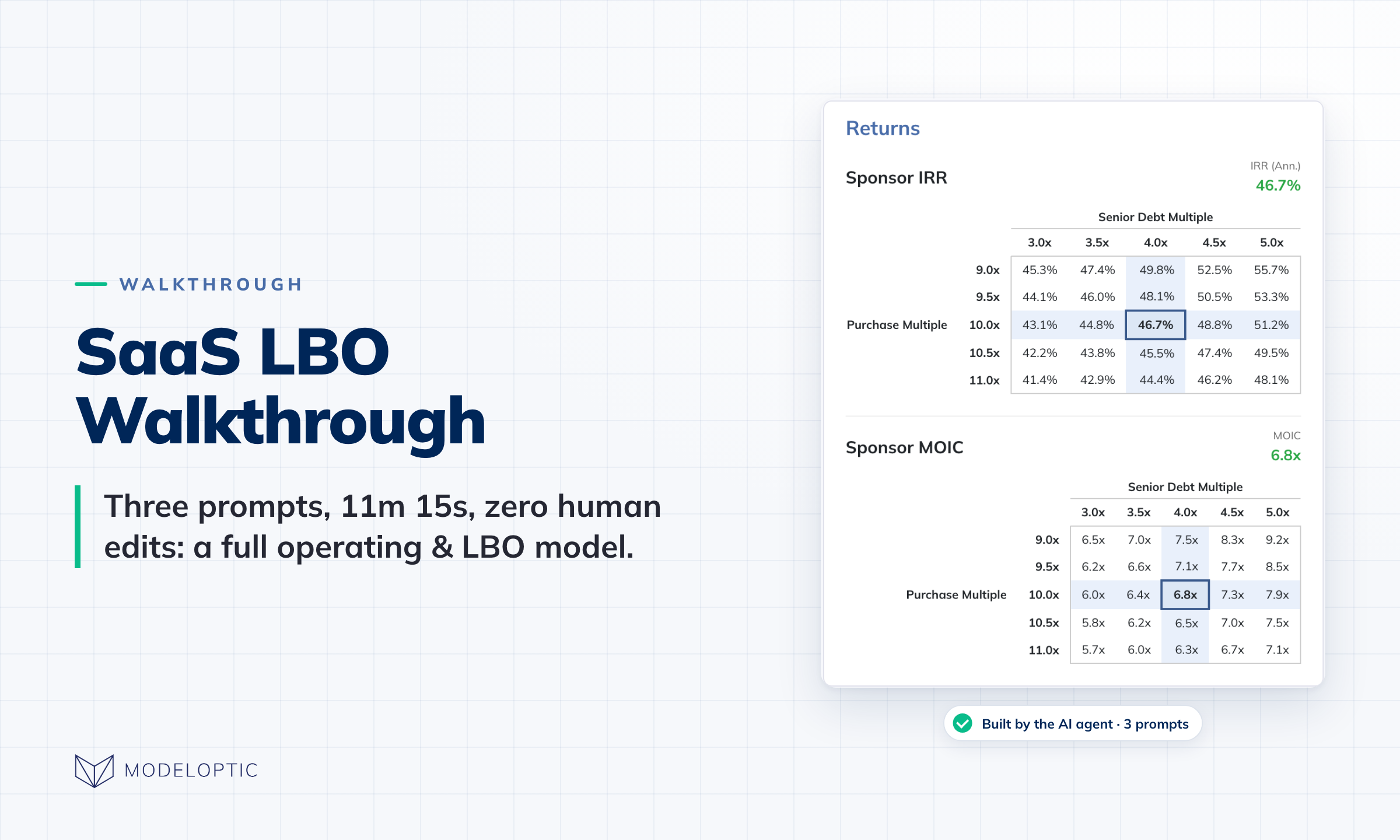
If you want to see the proof, see our walkthrough of a full AI SaaS LBO build here.
Software Agents
The first killer use case for AI agents has been coding. Anyone who has been using a frontier coding agent over the past year or two has seen a mind-boggling explosion of capability. My trajectory went like this:
- This is a really cool auto-complete. If I change the name of a variable on row 1, it'll see that I probably want to change the reference to it on row 2, and it automatically proposes that change for me, so now all I have to do is hit "Tab" and it's done
- This thing can write entire functions. I start creating a new function, it figures out what the function should do based on the name I gave it, and it writes the entire function for me
- If I make a thorough plan for a small, self-contained feature (like add a button that does something), I can give it to the agent, and it can write the entire thing for me with only a few mistakes that I can easily correct
- If I give the agent a vague, half-baked plan for a feature, it can identify the gaps and conflicts for me, propose resolutions for those, iterate with me on it a bit until we have a solid plan, then execute the plan, typically without any issues
In the past year and a half, I've gone from writing 100% of the code for my projects to less than 5%. Once I have a code change in mind, the starting point now is always to open up a coding agent conversation, not a code file. I think most software people who have been exposed to AI will now tell you the same thing. Not using AI for writing code now makes about as much sense as hand washing all of your laundry. That's how good coding agents have gotten in a very short period of time, and their rate of improvement continues unabated so far.
Software Agents → Financial Modeling Agents
I bring up coding because financial modeling, in many ways, is a lot like writing software:
- You have to cleanly manage data, logic, and outputs as separate things, or you're going to have a giant mess on your hands
- There's a certain way the pieces need to come together
- For part of the task, there are many established patterns for executing things the "correct" way
- For the rest of the task, there's a lot of subjectivity involved, but it still all needs to fit within a logical framework
- It takes skill, knowledge, and experience to produce a high quality result (or sometimes even ANY result that's not obviously broken)
This all means that financial modeling is an excellent use case for AI agents, as it can leverage all of the hard work that's already gone into improving AI models for software engineering. It's even better than that, because software is extremely open ended, whereas financial modeling is much more constrained.
AI Financial Modeling So Far
There are many ongoing attempts at bringing AI to financial modeling. Anthropic and OpenAI have Excel plug-ins, public demos, and benchmarks that target this space, and there are many other companies that have Excel plug-ins geared toward finance (including financial modeling in particular). Our view (and I think the current consensus view) is that while many of them are useful and often better than doing things by hand, they all still have serious deficiencies.
We think they're all coming up short because they're forcing the LLMs to manage all of the individual sheet-by-sheet and cell-by-cell complexity of a financial model in Excel, which uses a data format invented more than 40 years ago. LLMs are being forced to waste most of their energy on low level Excel mechanics rather than on the higher level concepts that are actually the core of financial modeling.
LLMs also have amnesia, so every time the user starts a new task, the LLM has to re-ingest and make sense of your cell-by-cell model all over again. As such, success using them in this environment has been muted.
What Actually Works: A Domain-Specific Language
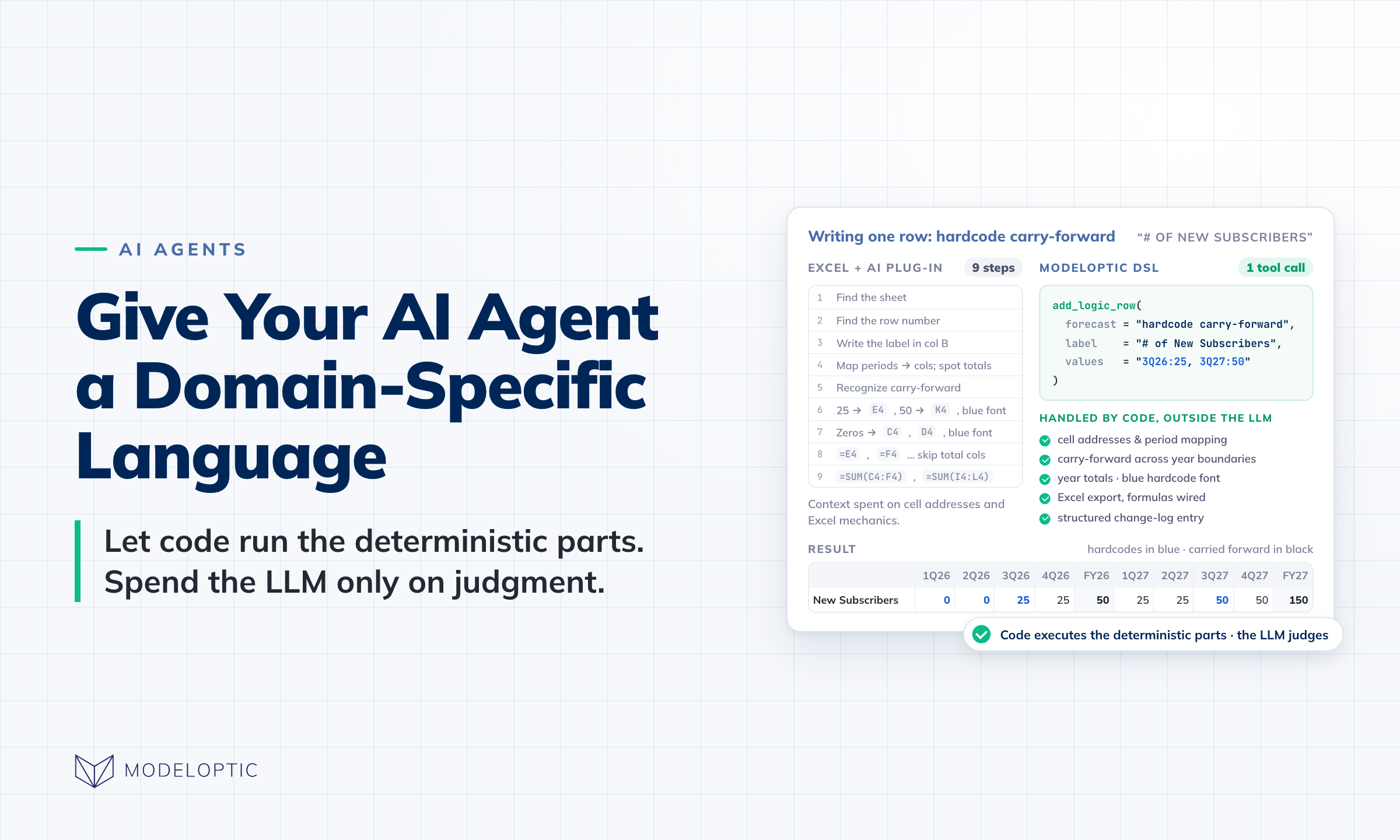
One of the ways we address this complexity issue is we created a "language" in which financial model logic can be specified, and let the agent use that instead (in software, this concept is referred to as a "domain-specific language", or a "DSL"). Then once the model logic is defined, the user can click a button to write the model to Excel, formulas and all. We let users use Excel as a communication and compatibility medium rather than try to force an LLM to utilize it as a data format.
A key feature of this language is that logic and formatting are specified at the table or row level, not the cell level. So if the agent decides that a particular line should be forecast using a trailing 12-month average, for example, all it has to do is specify "forecast method" = "trailing 12-month average", and the mechanical implementation of that logic is handled in code. In contrast, an agent that has to write its own formulas into Excel has to identify the cell address in which to write the formula, figure out which cells need to be referenced in the formula (including special treatment if a year boundary will be crossed), write the formula into the cell, do the same thing for the next period... and so on for every single cell in the projected period. And that's just a single row.
By letting our agent operate at a higher level, we unlock its capability so that it can actually clear the bar on being able to reliably produce high quality financial models.
We wrote more about this idea in Give Your AI Agent a Domain-Specific Language.
What Actually Works: Using a Purpose-Built Tool
Another lesson from Excel AI plug-ins is that as amazing as AI is, you can't just sprinkle AI on top of a problem and expect magic. The real world is complicated.
Here are some more key pieces that helped enable success for us:
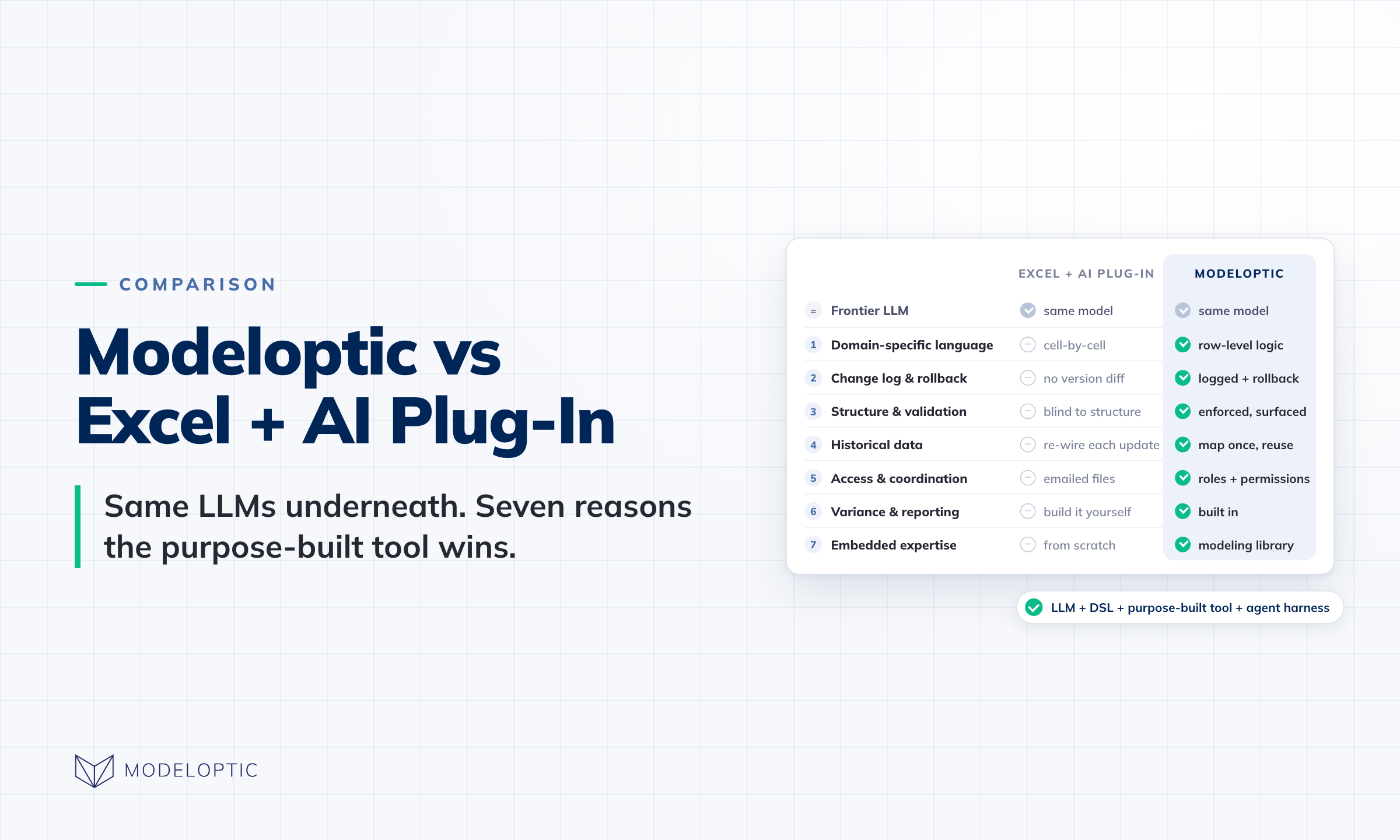
- Structure & Constraints. Financial statements must integrate with each other in very specific ways. Excel is blind to this; Modeloptic enforces it. It's impossible to have a balance sheet that doesn't balance in Modeloptic, for example
- Validation. If a model has unset or incoherent settings, broken references, or other obvious problems, Modeloptic surfaces these issues to the user (whether human or machine)
- Auditability: Version Control, Change Logs, and Rollbacks. This one is critical, and might even be a deal-breaker for serious AI Excel plug-ins for modeling. In Excel, there's no effective tooling to help you understand what changed from one version to another. Modeloptic shows you every individual change made to your model, who made it and when, and lets you step backward and forward in time at will
- Embedded Expertise & Best Practices. We provide our agent with an extensive library of financial modeling building blocks and industry-specific logic it can draw from. The agent doesn't have to figure out how to sweep excess cash to pay down debt or invent a deferred tax asset / liability mechanism on the fly from scratch when a request comes in; it can just look up the gold standard way to handle such a situation and implement it, which greatly improves accuracy and speed
For a more thorough rundown on this topic, see Financial Modeling: Modeloptic vs Excel + AI Plug-In.
Where We Go From Here
We've crossed the Rubicon: It's now clearly much better to do financial modeling with AI, just like it is for writing software. Every software engineer who has seen the capability knows that the world is different now, and there's no going back. The capability is simply too powerful to be dismissed anymore, and the same is now true for financial modeling too.
There's no question that LLMs will continue to get more and more capable over time, and probably very quickly. As such, Excel plug-in AI-augmented financial modeling will definitely improve too.
But at least for the current architecture of LLMs, I don't see any way raw LLM output can ever beat a competently constructed, continuously improving, purpose-built tool with an agent harness on top of the same LLM: